

There is a recognition that “this is the era of continual intersecting crisis” and the “multidimensional collision of crises” will continue to be the backdrop of our lives over the coming decade. This includes the war in Ukraine, the COVID-19 pandemic, black-live matters and a stream of scandals and organisational closures in the UK voluntary sector over the last 5 years.
The above is at odds with the popular project-based funding or payment by results model – despite it limiting an organisation’s ability to plan long-term and to adapt/respond quickly as needed[1]. Luckily there is growing recognition and awareness in the sector that core and unrestricted funding to support organisations is vital and more suited to current and future challenges.
Any Foundation working on system change has to be doing core funding. COVID-19 was really a wake-up call in this regard – philanthropy realised it needed to be more flexible and to give more core support in order to keep the field alive
Leslie Johnston interview, Laudes Foundation
But it is not easy to pivot in this direction – we found that funders struggle to justify the business case for unrestricted or core funding, in particular, to the Board of Trustees. Those successful talked about having onboarding conversations with new board members, one to one conversation once settled in roles and wholescale board redesign.
Here we outline three benefits and considerations to think about when looking to make the case, move or continue to fund in an unrestricted way, and to provide non-monetary support.
1. Organisational capacity and resilience
For organisations the last years have forced “a double pivot, on what we were working on and how we were working”, which is no mean feat. Unrestricted funding can provide stability in times of crises and uncertainty, ensuring there are resources to adapt and shift as required[2]. Unrestricted funding can be used for any charitable activities, is strategic and long-term in nature and it provides total flexibility in the use of funds.
The figure below provides a high-level summary of how unrestricted funding makes a difference, based on findings from our recent Backbone Fund Evaluation for Paul Hamlyn Foundation:

External pressures along with flexible and unrestricted funding have spurred on change and transformation for organisations that might not have happened otherwise.
2. Reframing impact
The journey is also about rethinking impact and support[3]. Funders spoke about the light reporting approach they use. However, the latter contributes to the lack of evidence around value and impact of unrestricted funding models that often acts as barriers to make the case, move or continue to fund in an unrestricted way.
Keeping the light touch nature reporting while jointly reflecting, capturing and better understanding outcomes and impact of a fund could improve current practice. Conversations can be focused on targeted learning questions or broader cross-portfolio inquiries that could be shared back with the field and be in the public domain. Internally this means reframing impact and getting better at tracking direct outcomes of this type of funding such as: organisational growth or survival, agility and resilience and improved strategic thinking, learning and planning – with a focus on DEI practice.
3. Adapt support to the different stages of an organisations journey
But we also heard that there are some moments of change in an organisation that need specific support (often beyond money) in order to navigate and flourish. Different types of support are useful at different stages and the role funders plays at different points might need to be different. For example, at the end of grant relationships, helping people to explore and design for grant exit strategies. Or knowing when it is time to let go of things and make space for new business models to emerge is important – organisations need support to come to that realisation and see that as a credible strategic choice. This is about not avoiding difficult conversations but creating the much-needed space for them.
The below figure visualises the key life stages of an organisation with types of funding and support. Notice the focus on the relational aspects of the support provided.
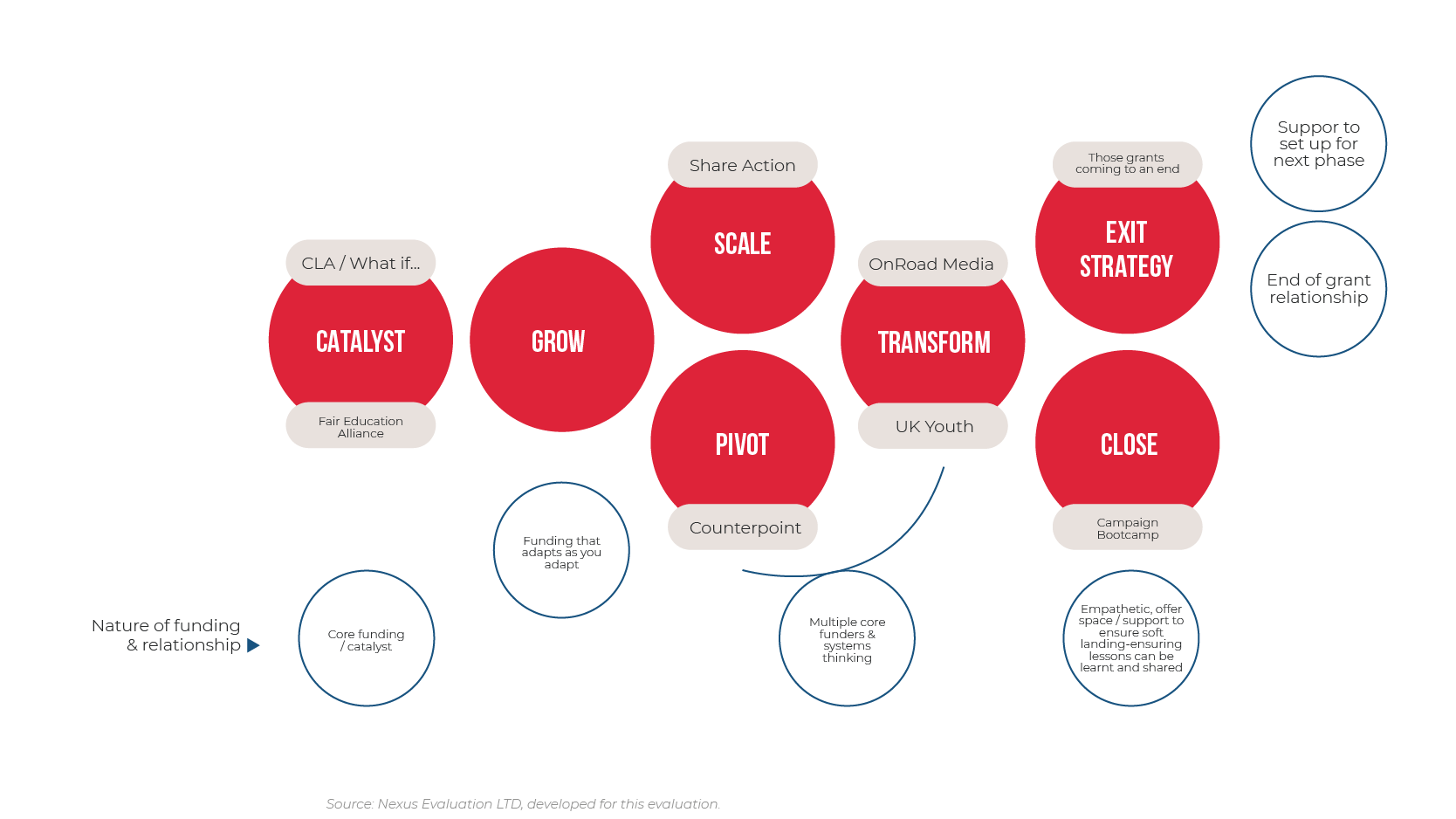
The above will likely need an increase in funder’s ability to discuss sensitive issues, to enable critical inquiry and joint learning with grantees – in addition to supporting personal, organisational and collective health and resilience as needed[4].
Key challenge – EDI Practice Funders we spoke to, support organisations through core or unrestricted funding on a basis of trust. They often do so to organisations they know and have supported before and have a certain level of trust with.
This is great for those organisations but can risk excluding other groups that most need this type of support. Local, regional and national Black and minoritised infrastructure organisations have been systematically underfunded and under recognised, and therefore unable to provide Black and minoritised communities with the links into funding that they needed – particularly during COVID.[5]
It’s a challenge to the relational funding practices that are growing and we strongly recommend to support more groups and organisations that are led by those who have been marginalised and haven’t built up those trusted relationships.
But funders can also support white-led organisations to be more DEI – this goes beyond existing guidance. The figure below visualises the different stages of a white-led organisations’ DEI journey.
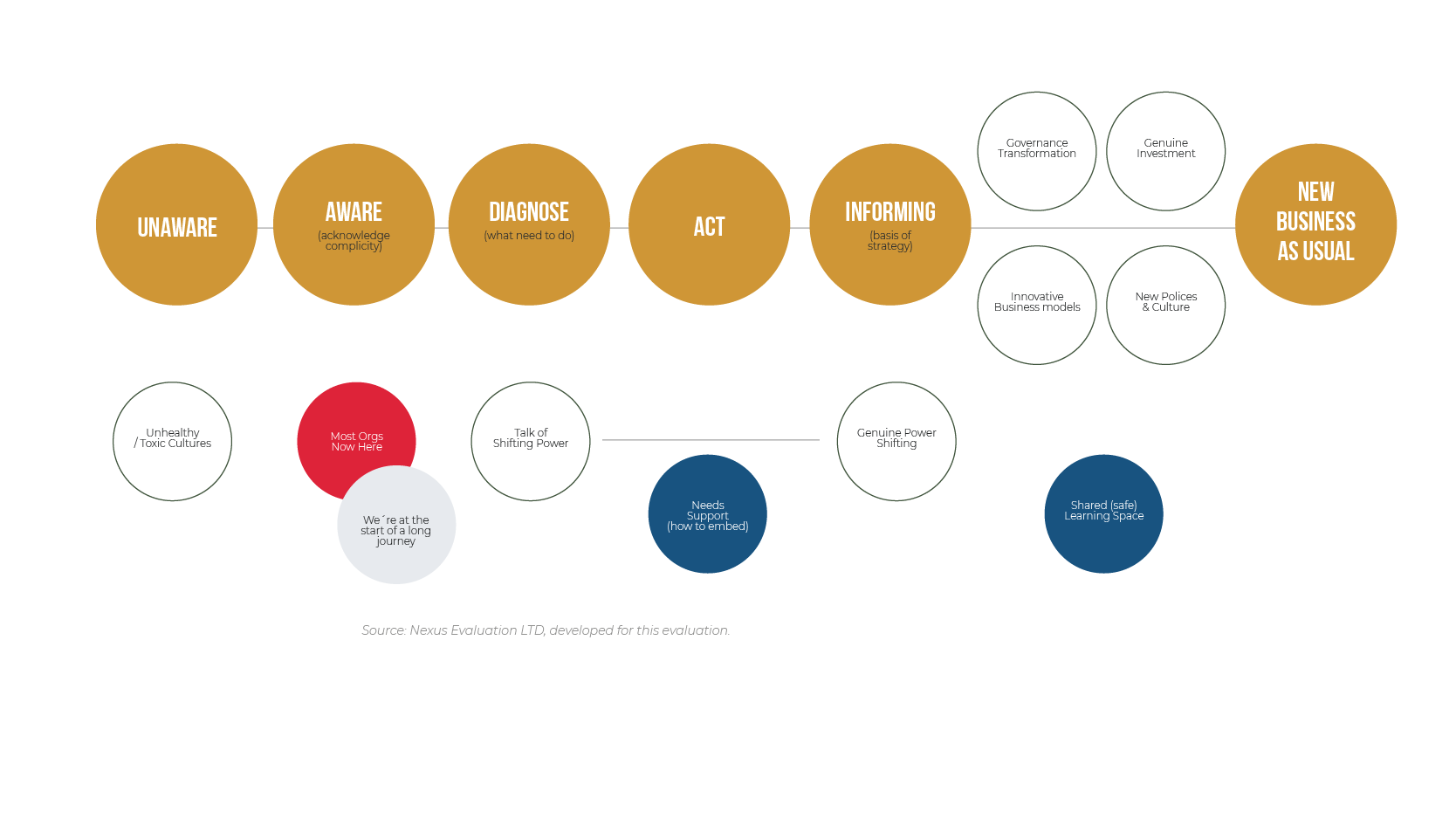
We recognise this makes its look like a straight forward / linear process – but of course it is a much more complex process with many twists and turns, which requires ongoing commitment.
[1] Similar insights and recommendations are made by Pro Bono Economics, based on new research. Available online here.
[2] Others also talk about it, for example “The holy grail of funding – Why and how foundations give unrestricted funding” (Nov, 2021), IVAR.
[3] Mike Scurati also makes a similar point in Four Increasingly Dubious Reasons Funders Are Still Not Giving Unrestricted Support (2023), Inside Philanthropy.
[4] Similar insights and recommendations are made by Pro Bono Economics, based on new research. Available online here. https://civilsocietycommission.org/publication/making-it-count-overcoming-the-barriers-to-better-grant-making/
[5] Natalie Armitage, Rana Zincir Celal, Yvonne Field, Rianna Raymond-William and Fancy Sinantha (2021) Booska Paper, The Ubele Initiative
 Nexus Evaluation LTD
2 thoughts on “ Critical Factors For Making the Case For Unrestricted Funding & Non-Monetary Support”