

Infrastructure organisations are inherently part of the fabric and background of civil society. And when infrastructure support works well, it is invisible and enables others to do more and so can be taken for granted.
Their primary role is to create an enabling environment for civil society to work effectively. And in time of crises and conflict, they can play a part in rebuilding the foundations of a resilient and diverse civil society (Common Vision report, p7). There is also some evidence that there is a direct correlation between the improvement of health and social indicators, in locations where backbone organisations operate (see for example Why social infrastructure is key to prevention).
What are backbone organisations?
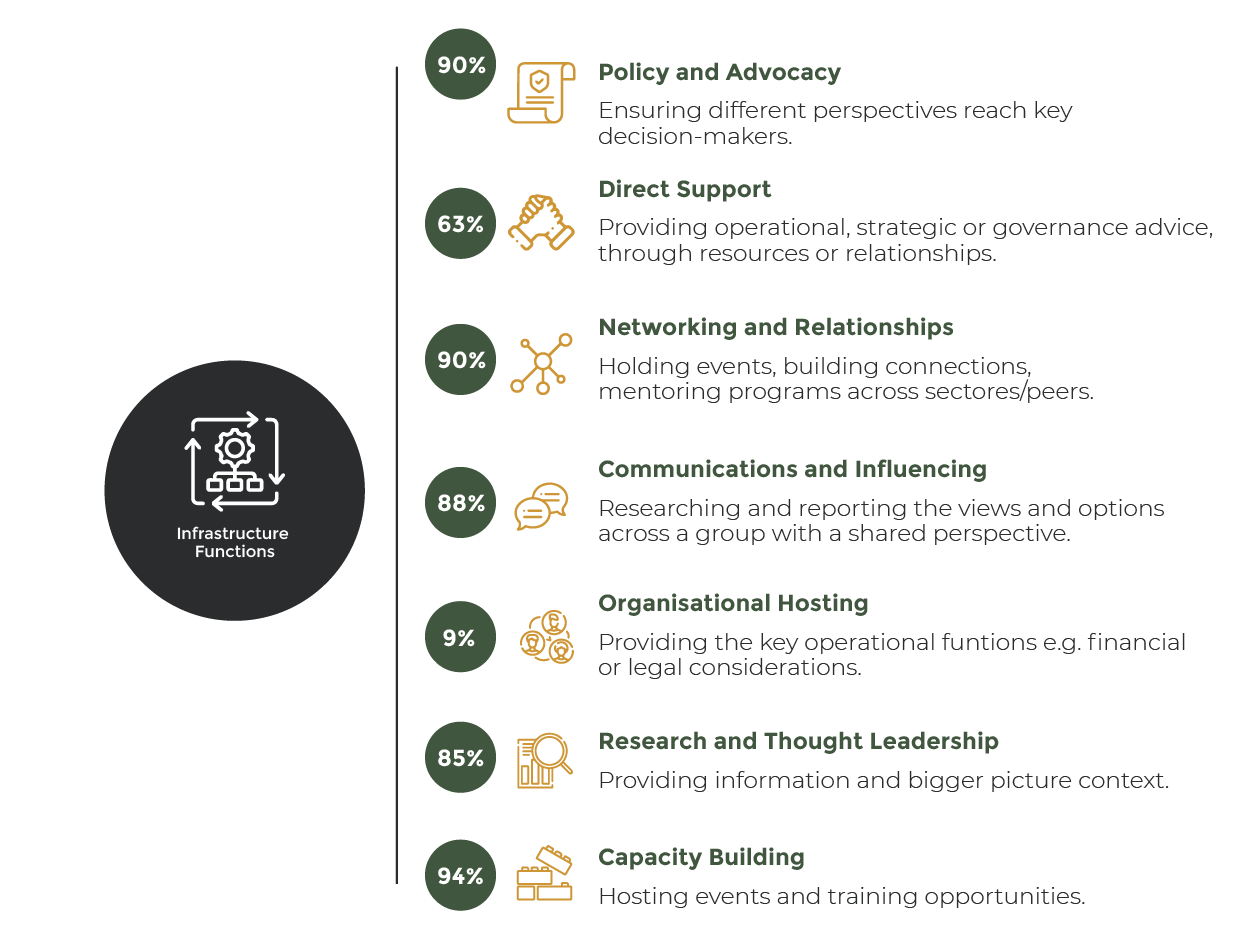
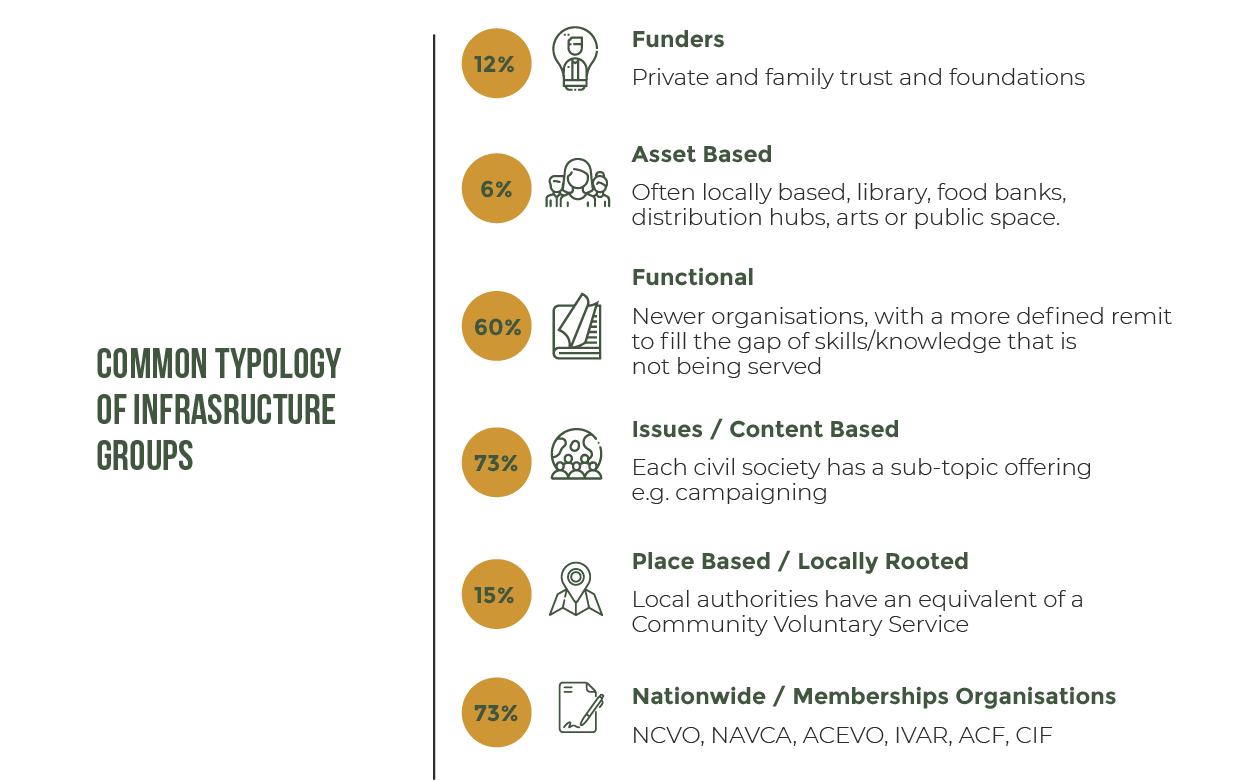
Thinking about infrastructure can feel quite high level and abstract. While on the surface infrastructure organisations appear very diverse, we see similarities when we look at the function they play and their business model. Through the Backbone Evaluation, we created two ways of thinking about infrastructure.
1. Functions – outlining the common functions and roles they play, with many organisations playing 3-4 of these roles simultaneously
2. A number of archetypes – a typology for the nature of the organisations. Often with an organisation straddling 2-3 of these. Expanding this beyond the type of organisations we might traditionally expect to also including funding organisations as a type of critical infrastructure needed for civil society to function.
Challenges facing infrastructure organisations today
The combination of the impact of Covid, toxic and unhealthy DEI practices and cultures and the ongoing pressures on infrastructure groups mean there is a small, but potentially growing trend around organisational ending and closure (e.g. Small Charities Coalition and Campaign Bootcamp). There has been a decline in investment over the last 20-30 years and loss of CVS support might be an intensification of longer-term trends, the impacts of which are only just being seen.
Changing economic contexts and government priorities over the past three decades have meant that infrastructure has waxed and waned in terms of recognition, profile, and public and charitable funding that it receives.
Common Vision report, p7
Many groups are also struggling with their business model and funding arrangements. Many infrastructure groups are network based/ membership-based organisations and have been struggling for some time. When staff bases and overhead costs are high, and civil society groups have less to spend on support, then membership fees are easiest to forgo.
The nature of the type of work infrastructure organisations do doesn’t lend itself to and is limited by project-based funding cycles due to the long term and sustained nature of the support required. Unrestricted and core funding can be a vital lifeline for these groups. (see our previous blog on this).
What type of support and infrastructure is required for a healthy and resilient civil society and voluntary sectors in the future?
The repositioning and reimagining of current infrastructure organisations alone is not going be enough what’s needed to deal with the inevitable changes that are happening and will continue to evolve over coming decades. As well as a current establishment of infrastructure groups and support, our work uncovered a number of burgeoning areas where more infrastructure / supportive ecosystem is needed – see visual summary below.

There are pockets of conversation and best practice starting to emerging in each of these areas, but in many cases it is still nascent, emerging and risk being overlooked and not funded.
We have also identified some common qualities and traits emerging that are relevant for current and – each of these taking sustained time, practice and investment to cultivate.
- Nature of relationships: challenging the current yet outdated parent-child relationship and connotations with those that are more peer to peer and mutual aid – where there is reciprocal exchange of resources and support for mutual benefit (over one part providing support to another that needs it)
- Nature of what is offered: From groups providing distinct expertise to enabling others and peer-assist approaches
- Scale of support: the more traditional infrastructure organisations are designed to support individual organisations and groups, the next wave of support is framed at infrastructure for ecosystems or sub sectors as a whole and on building individual capabilities for DEI-focused leadership.
All of this leads to a deep recognition of more joined up and intentional work is needed to bolster and best support infrastructure organisations – to ensure that civil society can contribute to the transformation of society at large and face the biggest issues of our time. Three key things are needed:
- Enable and resource established infrastructure to change and transform
- It might mean that some legacy infrastructure needs to close to make space for enabling infrastructure for the next century
- An investment in catalysing of new critical infrastructure and regenerative systems is required
To make this real we just need a handful of people willing to step forward to take this next step and create the space for the start of this much needed conversation.
 Nexus Evaluation LTD
One thought on “Future of civil society infrastructure”